Showing posts with label learning. Show all posts

Thursday, 26 April 2012

What about the Good Stuff?


The life of man is "solitary, poor, nasty, brutish and short" but this does not entail that good things do not happen. However, the worst thing that could happen to us and maybe Hobbes did not anticipate it was the additional time famine from which we are suffering today. I have not blogged for a while; teaching, examining, mentoring, parenting and studying have left me with no time to blog. Not much time to make a note of the good things happening, despite the fact that life IS nasty, brutish and short for a great number, if not all, human beings. It is a sad state of affairs when you do not make a note of the good things. To train myself to do this, i have divided my to-do list in four parts. Important Stuff, Good Stuff, Boring Stuff and Very Boring Stuff. (My friend, LS, suggested we add another section, Daunting Stuff. I am considering collapsing Boring and Very Boring or Important and Good, to allow for a neat division of the page in four parts. I am not sure when i will reach a decision, as i am debating whether the Important Stuff is necessarily Good or the Good Stuff necessarily Important. Issues of definition, perception and experience are standing in the way of groundbreaking developments in the area of to-do-list-making, but Daunting will definitely be there.)

So here is my confession: my Good Stuff list since the last time i blogged. I hope i am forgiven.

1. My Year 1 students had an interactive oral session on Kitchen by Banana Yoshimoto that made the room come alive with ideas and possibilities. The concept of the three-star question that i picked up from Erica McWilliam challenged them to higher levels of probing into the text and understanding its ambiguities. LS was there to witness it all and that made the experience even more precious, for the students who felt appreciated and worth observing, and for me, navigating my way in the new course (with so many others in the sidelines of the OCC forum) looking for good practice and improved student performance.

2. My lovely boarding student, S, prefaced this stimulating event with an equally stimulating and very enlightening presentation on Japanese culture. Might i add that she took the time to read the book in both languages before addressing my students? (No category exists for these experiences and the eagerness with which she picked up the phone to call her mother in Japan and ask her to send us a copy of the original).

2. The final draft of the second assignment for the online course was turned in on time. The design of a learning network for IB teachers with a focus on their professional development by creating a learning environment and a learning space for them has been completed. (Surprisingly, despite being famished for time, i did manage to spend a couple of days on JSTOR and other databases researching... ) Yes, the idea of a space where teachers can share what we know, learn more, share ideas, connect ourselves to individuals, professional communities and learning organizations is Good Stuff.

3. Quality time with the librarian=balm for the soul. Our lovely librarian had a little project prepared for World Book Day and i gave her a hand setting it up. (If she were to allow coffee drinking in the library i would seriously consider moving in there.) Her idea brought together book suggestions by members of staff and the outcome was an interesting list of books from around the world, dated from 200BC to 2012, books that can make one cry or laugh, books that have changed our lives. On that day i read an excerpt at school assembly from a book that i had chosen, viz. Paul Auster's The New York Trilogy, and our librarian tells me that students did ask her about it later. Several approached me asking for the title and the author again. This is Really Good Stuff.

4. Exams are approaching. We are all in one piece and getting there. This year i find myself in both camps. I will be examining and invigilating, but also sitting exams next month on the same day as our Economics and Biology IB students, in another venue and for another purpose. In solidarity with our IB students who are studying i moved my reading 'corner' outside. Where the sun is shining.

Saturday, 14 January 2012

"mais les vrais voyageurs sont ceux-là seuls qui partent pour partir"


I return to Baudelaire during critical times. Invariably. He lived in the 19th century.

The first week back from the X-mas break and all my students seem to be charging ahead, in one direction or another, at variable speed most of them and with variable momentum. But there is motion around me. There is feeling and there is a lot of talking, sometimes pointing to "the poverty within" as Pinter would phrase it. This week of my life was, yet again, a week about education.

First, the technology. I recently acquired a kindle, the purchase of which i proudly announced to my father, my model book-worm. Good, he said, another publishing house bites the dust then. But, dad, e-books are cheaper, easier to access, transport, share. I know, he said, but musician so-and-so, whom you like so much, has had only seven performances in December and January. And he does not earn anything in royalties because his music can be downloaded on the internet for free. (Counting the number of trees that i will save by using my kindle was pointless.) I put the phone down and picked up my kindle, went on reading Neil Postman's The End of Education where Postman discusses the gods of Economic Utility, Consumerism and Technology (p. 32): "technological innocence refers not only to ignorance of detergents, drugs, sanitary napkins, cars, salves, and foodstuffs but also to ignorance of technical mechanisms, such as banks and transportation systems". The technological advancement that started with such a bang in the 19th century is continuing and the baton is being passed on to the 21st century. The 20th century, my dad's world, is dead,. I was born and raised in this world; i will die in another. Do i feel the moral imperative to buy a print book for every kindle book i download? Probably. I will try to hold on to my dad and our shared world. (By the way black-and-white is back, but it's not the same. Satyajit Ray is black-and-white, 21st century isn't.)

Putting my personal technological and emotional dilemmas aside, the association of the 19th and the 21st centuries that Postman creates, reminds me of a similar point Erica McWilliam made at IBAEM regional conference in The Hague in October in 2011 with regard to education. Actually it is the very first point she makes referring to the emergence of disciplinary categories in the 19th century ('homo sapiens') and the need for "empathy, global consciousness, thinking beyond own generation, willingness to change and courage" for the new category that describes what humans are, i.e. 'globo sapiens' (a term attributed to Ian Lowe) in the 21st. How much of what we teach our students, in boarding and in the classroom, is still 20th century, or even the 19th? For example, do we still believe that if we throw people together, they will get to know each other and eventually get along? Contact theory does not always seem to work; look at America, look at South Africa or just look at some of our schools. Do we try to create a shared culture in our schools and do we value every stakeholder as a learner? Probably not, many of our processes in schools are managed in an authoritarian, rather than a co-constructivist way. Maybe we need a closer look at the culture in our schools, their structure and how we manage power. Do we lack courage? Are we unwilling to change, or even worse, resist change? My father is not unwilling to change; he is unable to do so. But for me, a teacher, it is important to have a kindle, use a smartboard, web 2.0 and much more. It is a moral imperative to have courage, empathy, the willingness to change and think beyond my generation. Because that's where my students live.

As Erica McWilliam suggests, the 21st century needs more than routine thinking in everything we do and learning matters more than knowing. What is in demand is the ability to see the part in the context of the wider and more complex whole and the ability to collaborate with others in ways that increase opportunities for successful innovation.

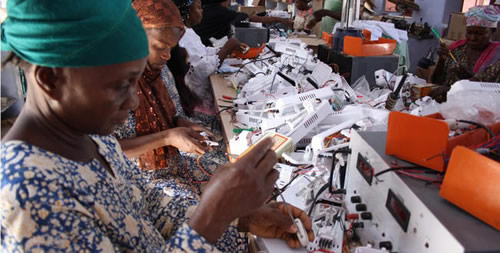
This week also, a lot of my students decided to write their ToK essay on the topic of discovering new ways to look at old data vs discovering more new data. The discussion led us to watching Sanjit Bunker Roy's TED talk about his Barefoot College. Illiterate grandmothers who do not speak the same language, working together to build solar panels are quintessentially Globo Sapiens of the 21st century. What are we?