Saturday, 4 February 2012

Meta-constructive or what's in a word?


(To my good friends, CC and MB, whose wise advice i did not take)


Thursday was my day off. Like every day off, i had great plans to do all kinds of things; catch up with the backlog of the last five years, re-read War and Peace and spend quality time with my significant other. Of course i ended up doing very little catching up or looking into my loving spouse’s eyes , spent a considerable amount of time (objective estimate: 20 min, subjective estimate: an eternity) on annoying and unnecessary email communication on problems that other people had created and were refusing to solve, charged my Kindle (this did not require too much of my time…), did some housekeeping stuff with mp3 recorders and cameras, spent a couple of hours on a task for the online course, but most importantly, I spent quite some time on the phone with my friend LS. Now this is what i call constructive. An interchange/activity centered on involvement, collaboration, consultation. An idea is put forth, someone responds, understanding follows, adjustment of the idea ensues, consideration of different perspectives, implications is introduced and on and on, so one constructs meaning/a new idea/experience/plan et c.; in short the learning cycle of do-learn-review-apply-do is followed. This is constructive, this is learning. But that was Thursday and this is what happens when i talk to LS.


The following day, however, i woke up to a new meaning of the word constructive. It’s like the definition in the dictionary was re-written overnight. On that day constructive meant indiscriminately tolerant, willfully ignorant, placatingly accepting, emotionally bland, and pointlessly questioning. Aber, Hallo! Is this a parallel universe or because of the relativist soup in which we are all swimming and our constant fear of conflict and confrontation, we have redefined constructive as meaning “i will not say anything that may upset you and i will not show my anger although i think that you are the reason for it”. Let me give you an example: you go to a coffee shop and you order a cup of coffee, the waiter takes forever, and when he does come the coffee is cold and the waiter is rude. You are angry and you tell the waiter that he was late, rude, the coffee was cold and that is not acceptable. According to today’s definition, this is not constructive. Why? Because you will not get another cup of coffee. And who cares? Not everything is about getting something. In other words, i need to be ‘constructive’ so i can get what i want or i need to be ‘constructive’ so the waiter will not be upset with me and maybe then i stand a chance of getting some hot coffee on time when i visit the coffee shop again. I need to educate the waiter about his job and the way he should treat customers. But it really does not go like that. I do not want the coffee. Not anymore. I want the waiter to know what his job is and i want him to know that sometimes he can be right and sometimes he can be wrong. I am not in the business of educating the world, I am in the business of educating my students and teaching them to educate themselves, so they will not be slow, rude and inefficient waiters. The rest of us, adults, need to agree on some meanings and live by them and their consequences.


Do I have anything against deconstruction, against the transcendental signified? No, i don’t. But i oppose selective and opportunistic deconstruction. You’re either with Derrida or you’re against him. You cannot say "Oh, it’s Tuesday, it’s my Derrida day of the week" or "I’m in a Derrida frame of mind" or "this creates a Derrida mood" or "this problem is not going away, let’s put some Derrida on it". Sometimes you just have to face the music.



Saturday, 14 January 2012

"mais les vrais voyageurs sont ceux-là seuls qui partent pour partir"


I return to Baudelaire during critical times. Invariably. He lived in the 19th century.

The first week back from the X-mas break and all my students seem to be charging ahead, in one direction or another, at variable speed most of them and with variable momentum. But there is motion around me. There is feeling and there is a lot of talking, sometimes pointing to "the poverty within" as Pinter would phrase it. This week of my life was, yet again, a week about education.

First, the technology. I recently acquired a kindle, the purchase of which i proudly announced to my father, my model book-worm. Good, he said, another publishing house bites the dust then. But, dad, e-books are cheaper, easier to access, transport, share. I know, he said, but musician so-and-so, whom you like so much, has had only seven performances in December and January. And he does not earn anything in royalties because his music can be downloaded on the internet for free. (Counting the number of trees that i will save by using my kindle was pointless.) I put the phone down and picked up my kindle, went on reading Neil Postman's The End of Education where Postman discusses the gods of Economic Utility, Consumerism and Technology (p. 32): "technological innocence refers not only to ignorance of detergents, drugs, sanitary napkins, cars, salves, and foodstuffs but also to ignorance of technical mechanisms, such as banks and transportation systems". The technological advancement that started with such a bang in the 19th century is continuing and the baton is being passed on to the 21st century. The 20th century, my dad's world, is dead,. I was born and raised in this world; i will die in another. Do i feel the moral imperative to buy a print book for every kindle book i download? Probably. I will try to hold on to my dad and our shared world. (By the way black-and-white is back, but it's not the same. Satyajit Ray is black-and-white, 21st century isn't.)

Putting my personal technological and emotional dilemmas aside, the association of the 19th and the 21st centuries that Postman creates, reminds me of a similar point Erica McWilliam made at IBAEM regional conference in The Hague in October in 2011 with regard to education. Actually it is the very first point she makes referring to the emergence of disciplinary categories in the 19th century ('homo sapiens') and the need for "empathy, global consciousness, thinking beyond own generation, willingness to change and courage" for the new category that describes what humans are, i.e. 'globo sapiens' (a term attributed to Ian Lowe) in the 21st. How much of what we teach our students, in boarding and in the classroom, is still 20th century, or even the 19th? For example, do we still believe that if we throw people together, they will get to know each other and eventually get along? Contact theory does not always seem to work; look at America, look at South Africa or just look at some of our schools. Do we try to create a shared culture in our schools and do we value every stakeholder as a learner? Probably not, many of our processes in schools are managed in an authoritarian, rather than a co-constructivist way. Maybe we need a closer look at the culture in our schools, their structure and how we manage power. Do we lack courage? Are we unwilling to change, or even worse, resist change? My father is not unwilling to change; he is unable to do so. But for me, a teacher, it is important to have a kindle, use a smartboard, web 2.0 and much more. It is a moral imperative to have courage, empathy, the willingness to change and think beyond my generation. Because that's where my students live.

As Erica McWilliam suggests, the 21st century needs more than routine thinking in everything we do and learning matters more than knowing. What is in demand is the ability to see the part in the context of the wider and more complex whole and the ability to collaborate with others in ways that increase opportunities for successful innovation.

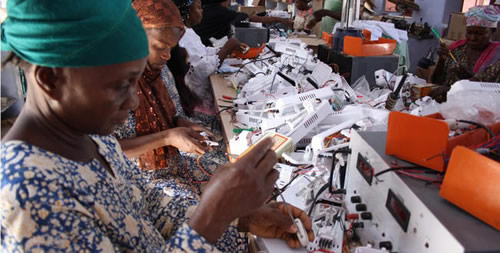
This week also, a lot of my students decided to write their ToK essay on the topic of discovering new ways to look at old data vs discovering more new data. The discussion led us to watching Sanjit Bunker Roy's TED talk about his Barefoot College. Illiterate grandmothers who do not speak the same language, working together to build solar panels are quintessentially Globo Sapiens of the 21st century. What are we?

Thursday, 8 December 2011

Goodybye, stage!


The last performance of the student-directed one-act play where i played a comic role as the prim, proper and uptight lady that comes to take a young man to his death was on Monday. The Theater Arts teacher, the students and i were glad it was over because we are all so frightfully busy. But we were also sad it had to end. Because yes, it was a lot of fun. It was a great process of coming together, of working on something that is not part of a syllabus, of addressing a real audience. It was exhilarating to be on stage and it was particularly exhilarating to be on stage with the students.
The adults had some particularly funny moments; like when i said "of course i mean dog" instead of "of course i mean god" at rehearsals. Learning my lines was not as easy as i thought it was going to be. And trying to take my lovely student to his death was a bit awkward. Rehearsals were another demand on what precious little time we have in the midst of deadlines and assignments.
However, the energy of the theater, in all its forms, remains highly empathic and cathartic. (I could say therapeutic too, but i do not want terminology to distract me from the issue.) As a theater-lover and educator, i feel that it is the only tool we have for communication on a cognitive and emotional level, but simultaneously with a symbolic and conceptual content.
The theater is a mode of thinking and a mode of enquiry. Thank you, Keith LeFever, and IB students, for reminding us.

Sunday, 27 November 2011

Oedipus outside Colonus

Deciding to teach Greek tragedy to my Year 1 IB Eng A Lit class has proved to be a very bold decision. I resisted it for many years because i was taught Greek tragedy at school and university. On the one hand, i felt that my experience as a student of a text in Greek would not transfer well into teaching and on the other hand, it presented a cultural challenge that i did not assess as manageable for young people today. Not really shifting my perspective, i did put a tragedy on my syllabus for the new course. The new motivation was based in exactly what had prevented me from teaching tragedy before; that both students and I would be challenged. We should be able to spend some time in discomfort and if the value of literary texts lies in the interpretation and evaluation of ambivalence, among other things, then there is a tragedy that fits the part very nicely: Oedipus at Colonus. Although the story pre-dates Antigone, it is the last of the Theban plays that Sophocles wrote, in all the maturity of his dramatic art and in the context of the city of Athens ruled by the Spartan-backed dictatorship of the Thirty Tyrants.

Despite my misgivings and the level of the challenge, the students have responded adequately and with considerable reflection on several aspects.

First, Sophocles' philosophy and the greatness of the Tragic Hero. However, the concepts of reverence (ευσέβεια) and wisdom (φρόνησις) that Sophocles speaks so much of, are not easily translatable, especially since reverence extends beyond morality in Sophoclean works.

Second, the Aristotelian aspects of the Tragic Hero and the notions of pity and sympathy received a lot of attention, often in very lively and engaged classroom discussions.

Third, as we paced ourselves with the conceptual difficulties that the play presents, even for scholars, the first secondary source was introduced and it was very encouraging to see how young adults responded to the arguments that Ahrensdorf presents with regard to political rationalism as represented in the character of Theseus and religious passion in Oedipus. Oedipus is shown to be self-contradictory and self-destructive in Ahrensdorf; this very human aspect that invites Kitto to talk about the "essential greatness [of the Tragic Hero that] impresses itself at last on the gods themselves" (Kitto: p 127) was very accessible to young adults, despite the identification problems that Oedipus' old age presented. In essence, the perception of the play as being about the dignity of being a man and the anger we feel at our mortality was shared by the students. I suppose this is telling of the enduring value of the play as a work that delves into an examination of the human condition and its precariousness. Interestingly, Theseus, who is deemed to be the protagonist of the play by Ahrensdorf, did not receive as much attention. The tension between the personal and the political was found weak and the personal always won in the students' comments. Although they have a good grasp of political notions and they do possess a political discourse, albeit one lacking in sophistication due to their age and experience, Theseus' political rationalism, which does not underestimate the power of religion, emerged more as rhetoric rather than conviction. Given that the audience is not a-political, can one assume that the political message is lost on them and therefore, the shortcoming lies with the work? I suppose not. My interpretation is that the experience of our students has been shaped in such a way that the political is not expected to be prioritized as an issue in a literary work. Their intuition is that: 1. the person everyone talks about is the protagonist and 2. the story in a book is about someone's adventures, suffering et c. This reaction to Theseus reminded me of the famous experiment by Chabris and Simons with the invisible gorilla. When you are trying to count the passes amongst team members at a basketball game, you miss the gorilla that walks through the court. When all this fuss is made about Oedipus- and this has been going on for centuries, thank you very much, classics scholars and Mr Freud- how can one notice Theseus?

The fourth aspect in the modern challenge of Oedipus at Colonus regards the story line. Because there is not much of one. I would like to generalize and say that students expect literary works to have a story and a plot and involve some action. But this would not be true as in the last ten years of my teaching, students have responded very positively and insightfully to plays without a story such as Beckett's Waiting for Godot an Ionesco's The Bald Soprano. Then the conclusion would seem to be that students today can relate to the Asburd more than they can to Sophoclean concepts and ideas. A valid conclusion indeed, and one that offers us some food for thought, as on some level, Sophocles and the Absurd do share the preoccupation with the human condition. Notably, there is one clear cultural obstacle in the understanding of Oedipus at Colonus by some of our students and this is the nature, character and will of the greek gods. Having named my son after a hero killed with the help of Apollo, a decision i made when I was their age and long before I did have a son, educating them about the greek gods becomes a more personal task. Today, having read Ahresndrof i see my decision as political.

To be fair to all, half of the students in my group are studying Antigone for another Lang A course and the other half Oedipus Tyrannus. They are Theban scholars in the making. They will be rewarded next week with Woody Allen's version of tragedy, Mighty Aphrodite. After we discuss Yeats' A Man Young and Old, part IX, an adaptation of the first stasimon in Oedipus at Colonus, based on Richard Jebb's translation.

Maybe we can recover some continuity in the fragmented post-modernist tradition of the 21st century. Or, to quote Oedipus: "So, when I am nothing, then am I a man?"

Wednesday, 2 November 2011

Go Global

Between a 3-day seminar at a retreat with colleagues from school and a visit home to check on things, i spent three brilliant days in The Hague attending and presenting at the IB Inspiring Conference.
The IB is opening its Africa, Europe and Middle East global center in The Hague, a move that is part of the new structure of the organization, but also one that carries some symbolism because of the location itself. Beyond the symbolism, it was inspiring to listen to Erica McWilliam (one can get a taste here) and other speakers about empathic leadership, the IB research unit, the academic developments in the organization and IB recognition.
The new strategic plan and the new language in the organization are typical examples of a change that is directed from within, but with an agenda that reflects the changing world we inhabit. In this sense, the organization is responding to the educational landscape that emerges with initiatives and planning that will promote access and diversity of educational needs, with the Career Certificate and IB online courses.
This short entry is just to register my personal excitement (a more analytical response may follow when i have less homework). I am sure that change and growth inspire misgivings in others, maybe with a good reason, but as a teacher that is aspiring to becoming trans-national, i cannot help thinking that continual inquiry and perpetual motion are the concepts and also the course of action required to face up to the challenge of modern education. For more excitement, watch this space.

Monday, 5 September 2011

Nostalgia


I have been meaning to blog about nostalgia ever since i returned from a wonderful summer holiday, but nostalgia itself kept me from doing so, making the distance between me and the topic minimal and threatening. As a student and speaker of Greek i cannot help associating nostalgia with pain (άλγος), even if it's only due to linguistic reasons. On an emotive level, i find it very close to loss and deprivation.

During several attempts to discuss these issues with my students, they became uncomfortable and nervous, giving me the impression that i was touching a chord that was very close to their intimate emotional space. They, too, were experiencing some kind of nostalgia that they did not or could not express. These experiences and considerations led me to a little reading project (indeed infinitesimal, given the bibliography on the topic in several disciplines) on memory and nostalgia. Meandering through the platonic notion of the ever-reborn soul and the psychoanalytical ideas about memory and forgetting, i came across a different perspective of nostalgia in the Handbook of Experimental Existential Psychology (2004, Greenberg, Koole, Pyszczynski eds.) by Sedikides, Wildschut and Baden in the chapter titled Nostalgia: Conceptual Issues and Existential Functions, a perspective that gave me new insight into the world i inhabit, that of middle-aged adults, adolescents and literary characters.
According to Sedikides et al. nostalgia is "a positive emotional and experiential reservoir that people delve into to deal with existential threat." First, by putting together pieces of our past life, we solidify the unification of self. Through resorting to an idealized past, we strengthen our ability to deal with the present and restore our self-worth. Second, the meaningful cultural context that we create with nostalgia makes our life more purposeful and creates better understanding of how we fit into this particular context. Third, nostalgia reestablishes a connection with significant others by bringing them from the past into our present. Significantly enough, nostalgia is seen overall as a universal experience and a stock of positive feelings.

I am hoping to bring all these aspects of nostalgia into my classroom and into real and imaginary discussions with people from the past and characters from books i love. Of course my next entry will be about the present.

Sunday, 17 July 2011

fruit flies like an arrow, fruit flies like a banana (Groucho Marx)


After results, it is fitting to spend some time evaluating and reflecting on our principles and practices, our shortcomings and our vision for the future that awaits our students. In a convenient self-censored way, here are my thoughts in quotes.

1. insanity is doing the same thing over and over again and expecting different results (Einstein?)
2. you cannot teach anyone if you have given up on them (mine)
3. the IB is a program for motivated students, they will succeed in a culture of learning (mine)
4. all members of the IB school community should see themselves as IB learners (JWo)
5. if you cannot take the heat, then get out of the kitchen (Harry S. Truman)
6. we all get what we deserve, whether we deserve it or not (Molly Dodd)
7. wilful ignorance disguises grim reality (Siri Hustvedt)
8. the limits of language are the limits of my world (L. Wittgenstein)
9. misunderstandings occur when no one is listening (Philipp Keel)
10. yes, we can. (Barack Obama)

("Life? Don't talk to me about life! Here I am, brain the size of a planet and they ask me to take you to the bridge." Marvin, The Paranoid Android in Douglas Adams' The Hitchhiker's Guide to the Galaxy)

Please feel free to reply to my cliched self-expression. And by the way, my students did very well.
(widows' memoir project postponed indefinitely...)